


Your permission
You choose what connects.
BioBalance is permission-based. You decide what information to share, and you can change or remove access.
 Wearables
 Labs
Labs Nutrition
 Medications
 Symptoms
 Sleep
Sleep Activity
 Mindfulness
 Environment
How it works
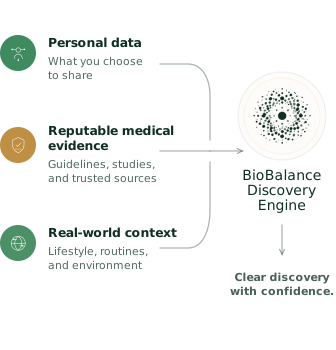
BioBalance brings together the information you choose to share, reputable evidence, and the context of your daily life—then surfaces possible patterns with transparent confidence.
You decide what to share.
BioBalance aligns relevant information into a personal timeline.
Possible patterns are considered alongside reputable sources and real-world context.
Insights include confidence, limitations, and what remains uncertain.
Understanding can evolve as relevant information grows.
Your permission
BioBalance is permission-based. You decide what information to share, and you can change or remove access.
WearablesLabsNutritionMedicationsSymptomsSleepActivityMindfulnessEnvironmentOver time
Relevant signals are aligned across days and weeks so changes can be considered in context.
The same timeline can make it easier to see what changed, what stayed consistent, and what may need more context.
Evidence + context
Three pillars come together in our evidence-based process.
Transparent confidence
BioBalance communicates how well a possible pattern is supported. Confidence can rise, fall, or remain uncertain as information changes.
Limited, early, or inconsistent information.
A possible pattern appears, but more observation or testing is needed.
The association is repeated and relevant evidence aligns.
The available evidence is unusually consistent, but confidence is not certainty.
BioBalance surfaces associations, not proof of causation.
When evidence is not enough
Missing information, conflicting signals, limited duration, measurement noise, or weak evidence may prevent a reliable conclusion.

Real life
A workout is one piece of context. BioBalance may also consider sleep, stress, nutrition, recovery, routines, symptoms, and environment—using only the information you choose to share.
By design
Your information belongs to you.
You decide what to share and with whom.
You can see the sources and context behind an insight.


 BioBalance surfaces associations, not proof of causation.
 Discovery Engine
 Navigator
 Personal Experiments
 Health Story
 WISEiD
